Leadership
Ran Avrahamy, Hagar Nahum Brockmann, Chen Guter
Dream Team
Hen Paldi, Becky Shafiki, Tal Tenenbaum, Liat Berry, Oz Ganor, Eyal Chowers, Tamar Knobel, Aviya Alkabets, Kido
Motion Design
Or Drori
Typeface
Formula, Pangram Pangram Foundry
Created as part of my work at AppsFlyer as a Senior Brand Designer & Rebrand project leader
AppsFlyer helps businesses understand, measure, and accelerate growth.
But in a category increasingly shaped by AI and saturated with familiar visual patterns, communicating growth had become surprisingly difficult.
I joined the company to lead a repositioning and rebrand initiative focused on building a visual system that could scale across a global organization while creating something more evocative, emotionally engaging, and distinctive.
Beyond the Category
AppsFlyer wanted to communicate its role as a growth engine in a rapidly evolving industry.
In a category where technology brands had converged around the same visual language, the challenge was not only to communicate growth, but to do it in a way that felt specific and emotionally resonant.
My visual exploration gradually moved away from familiar tech aesthetics and toward something more atmospheric and experiential - ideas that felt universal enough to build a long-term visual system around, while remaining rooted in what AppsFlyer enables for its customers.
The Horizon
As the exploration evolved, the horizon emerged as a recurring reference point.
What began as a visual reference gradually became something broader. Beyond its appearance, I became interested in the behavior it represents: movement, expansion, and a sense of possibility.
The horizon carried an emotional quality that felt important to preserve. A sense of openness, optimism, and forward momentum that could express growth without becoming overly literal.
Rather than building the identity around a fixed symbol, I began thinking about it as a set of visual principles: horizontal movement, expanding forms, light, scale, and progression.


Thinking in Motion
Motion wasn't treated as an application of the brand, but as a core part of how it would be experienced.
The ideas at the heart of the concept - expansion, light, and optimism - felt difficult to capture through static imagery alone.
Working closely with motion designer Or Drori, we began exploring motion as the foundation for the image-making system. Over several weeks, we experimented with ways to translate horizontal movement, light, and expansion into a visual language that could feel emotional and atmospheric without becoming overly literal or abstract.
Instead of creating a single hero visual, the goal was to define a behavior. A visual logic capable of generating an entire family of images while remaining coherent and recognizable across different applications.
Together, we developed a system of flowing gradients and evolving forms derived from movement itself. Static visuals were extracted from motion, allowing the image-making to retain a sense of energy, depth, and continuity across the brand.
As the work progressed, these explorations began informing a broader motion language that extended beyond image-making into the wider identity.
By the end of the process, motion was no longer just one component of the identity. It had grown into one of the foundations of the brand.
Structure and Precision
While the image-making system expressed movement, energy, and possibility, the supporting graphic language introduced a second layer built around structure, precision, and control.
Drawing inspiration from diagrams, schematics, assembly instructions, and technical systems, it reflected AppsFlyer's role as a platform built around measurement and intelligence.
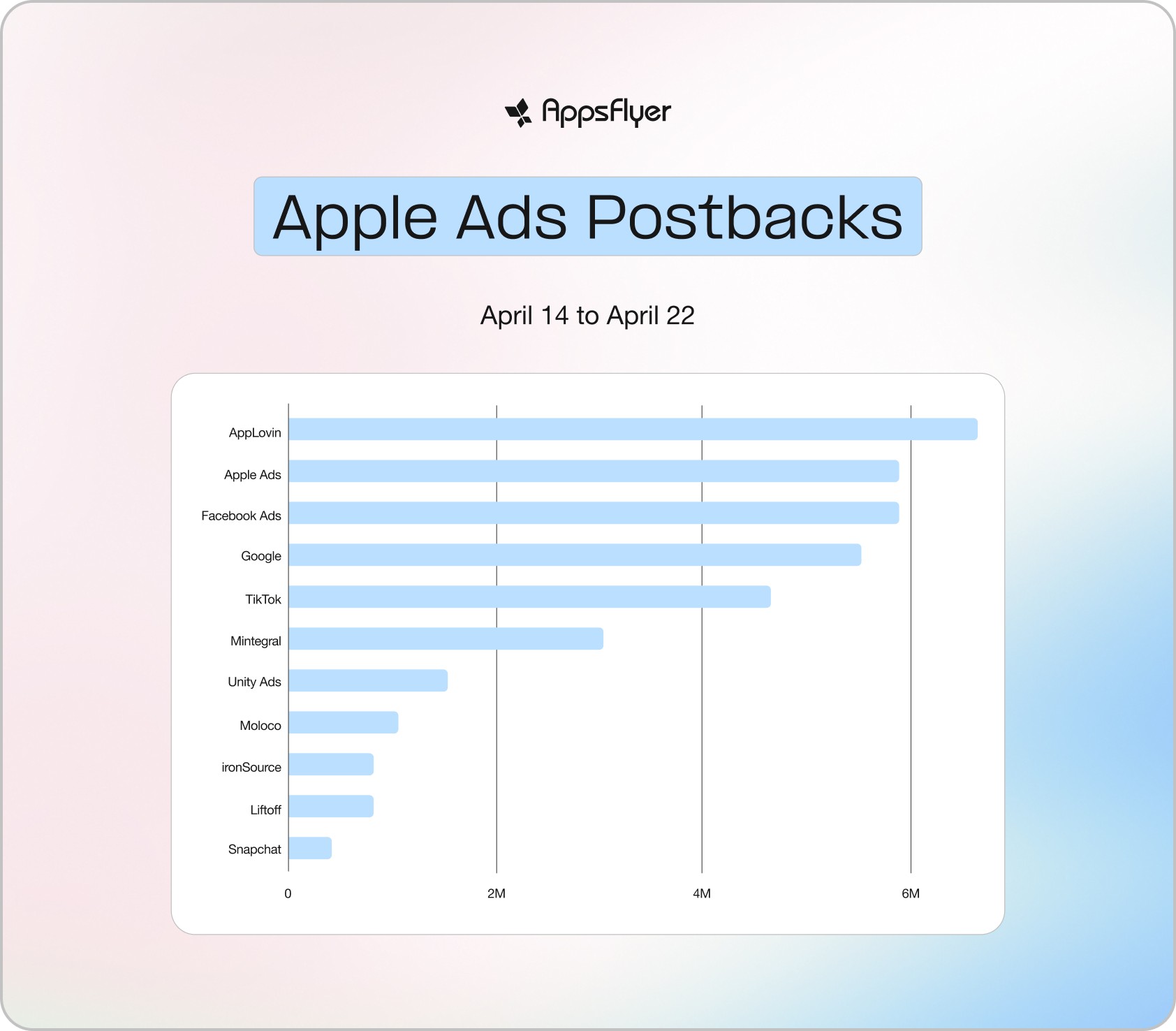
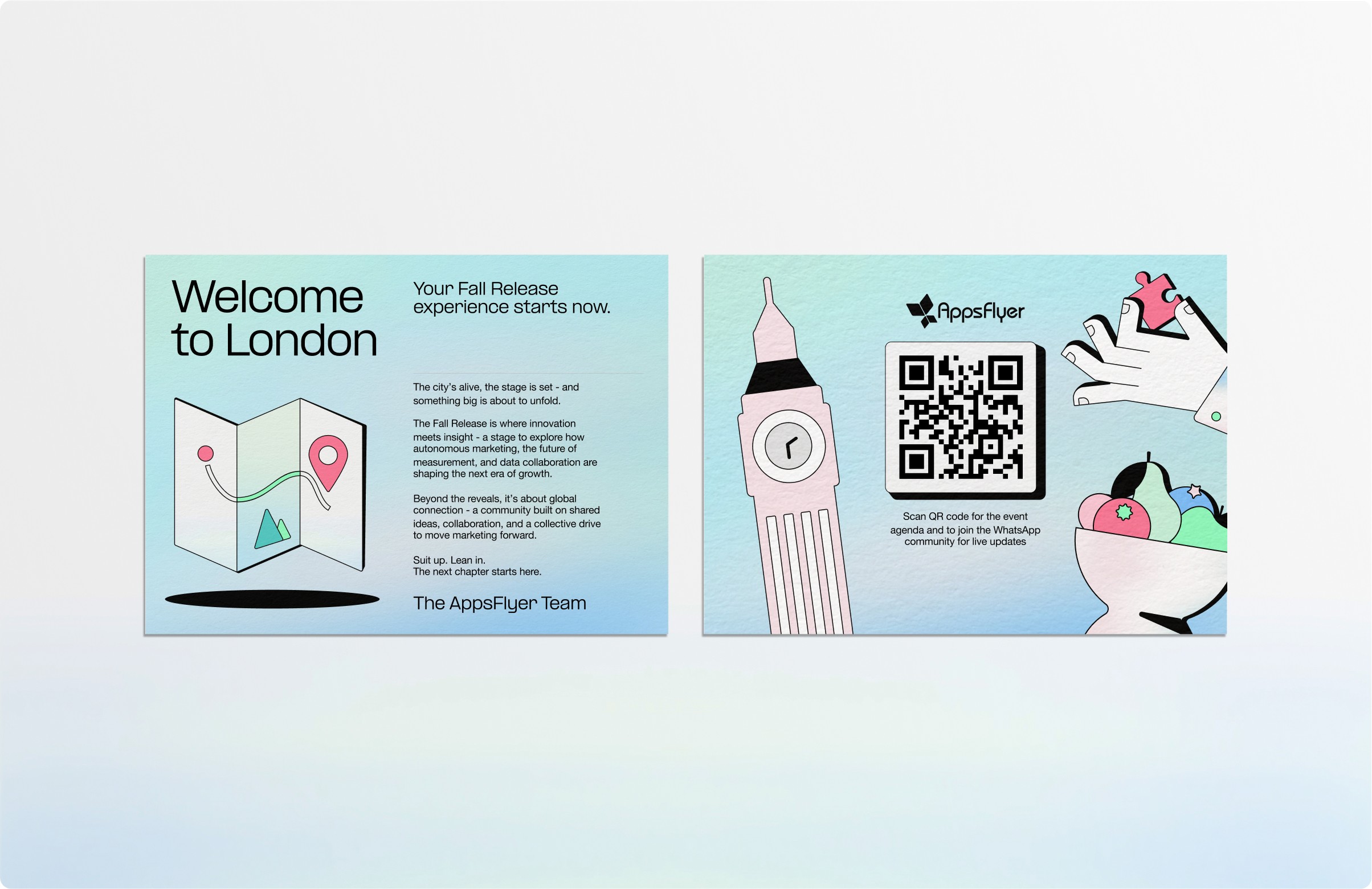
This structured layer extended beyond typography and graphic components into a broader set of communication tools. Icons, spot illustrations, and infographics were designed as part of the same visual logic, helping translate complex ideas into clear, expressive, and recognizable brand moments.
These elements formed a connective layer between function and storytelling, balancing precision with personality.
Together, the two systems - fluid energy and structured precision - formed the foundation of the identity.




Designing in Parallel
Developing the concept was only one part of the challenge. The next step was turning it into a system that could scale across an entire organization.
The timeline was ambitious, requiring brand, web, motion, events, presentations, illustration, advertising, and product touchpoints to be developed simultaneously rather than sequentially.
To support that pace, I assembled a team of designers, illustrators, and motion specialists, expanding the project beyond the core in-house team.
To maintain coherence across a rapidly expanding brand, I established weekly design reviews that became a core part of the process. They created a shared space for discussion, feedback, and alignment as different areas of the brand evolved in parallel.
While each contributor took ownership of a specific discipline, the work was continuously reviewed as a whole, allowing the system to grow organically while maintaining a shared visual language.
This approach made it possible to move quickly without sacrificing cohesion.
The identity wasn't finalized in a brandbook and then rolled out - it was shaped through implementation, allowing ideas to be refined, challenged, and strengthened throughout the process.




The Brandbook